Euwallacea fornicatus sensu lato

Biocontrol of the tea shot-hole borer

Common name: Tea shot-hole borer
Scientific name: Euwallacea fornicatus sensu lato
Order: Coleoptera
Affects: Populations in crops, ornamental plants and forest species.
Main season: Spring, summer and autumn

General information

Euwallacea fornicatus is a group of beetles known as ambrosia beetles of the family Curculionidae. These insects are characterised by being a highly polyphagous type of beetle, which can attack numerous species of forest, ornamental and agricultural trees, including avocado trees. Their ability to colonise fast and the damage they cause to plants by inoculating ambrosia fungi make them a pest of great agricultural and ecological importance in various subtropical and Mediterranean regions.


Morphology and biology

Each stage of Euwallacea fornicatus life cycle is adapted to the morphology of the insect, allowing it to grow in its specific environment, mainly inside tree trunks and in symbiosis with fungi of the genre Fusarium, Graphium and Paracremonium. The eggs of Euwallacea fornicatus sensu lato are small, oval-shaped and white in colour. They are laid by the female inside the galleries she has bored into the wood of trees.

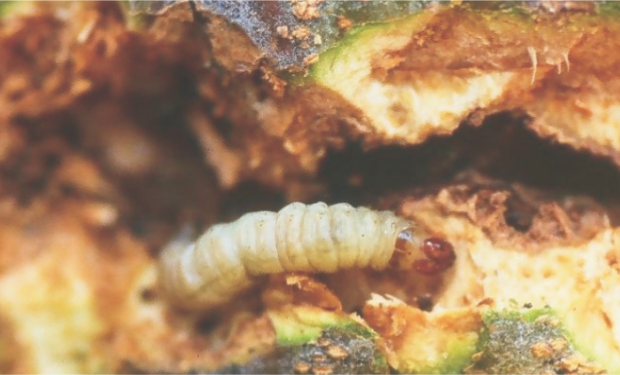
After approximately two weeks (depending on environmental conditions), the elongated, cylindrical, legless larvae begin to feed on the ambrosia cultivated on the walls of the gallery drilled by the mother.

During the pupal stage, they are white or light yellow in colour and have a compact structure. The pupa does not feed and remains in a state of rest inside the tunnels while it completes its metamorphosis into an adult.

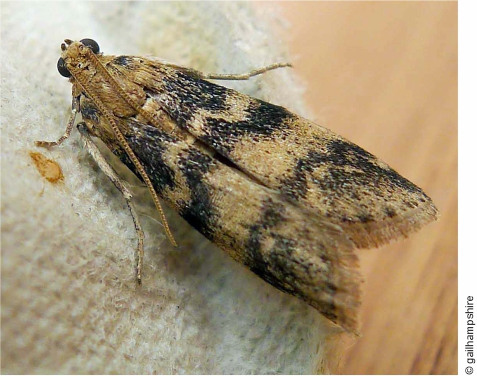
As an adult, Euwallacea fornicatus sensu lato can live for several weeks, depending on environmental conditions. The adult is small, approximately 2 to 3 mm long, with a robust shape and dark colour, usually black or brown. The insect has a long face (beak), which allows it to pierce the bark of trees to form galleries where it lays its eggs. For the most part, they use flight to disperse over relatively long distances, up to several kilometres, and can move on foot. Their characteristic L-shaped antennae are adapted to detect kairomones such as ethanol and other compounds that are helpful for them to find the right tree for reproduction. Sexual dimorphism is highly evident. Males are born from unfertilised eggs and are haploid. They are smaller, have little chitin and atrophied wings, preventing them from leaving the galleries where they were born. Their role is to reproduce with their own sisters, which is not a disadvantage for the species due to their DNA repair tools that protect them from the negative effects of inbreeding.


Damage

The damage caused by Euwallacea fornicatus sensu lato can be both direct and indirect and affects both plant health and agricultural productivity.

Fertilised females pinpoint plants susceptible to attack due to the emission of ethanol produced when the plant enters a state of stress. They bore tunnels into the wood, where they dig larger tunnels in which to lay their eggs and where the larvae will develop. These larval tunnels are lined with ambrosia fungi, which serve as food for the larvae. The female controls the fertilisation of the eggs, so that only females are born from fertilised eggs. Males are born from unfertilised eggs, have no wings and never leave the gallery, reproducing with their own sisters.

The ambrosia fungi are transported by the founding female in specific organs called mycangia. These fungi germinate on the walls of the gallery and invade the plant tissues, causing damage of varying severity depending on the species and vigour of the plant host, which will affect the productivity of the trees and may even kill them.

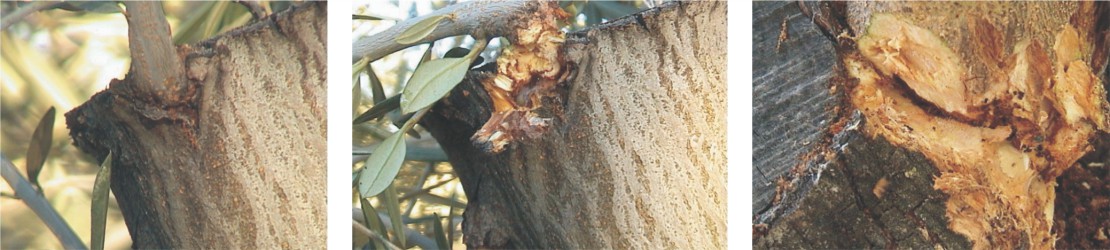
The weakening can be difficult to detect. The most distinguished symptoms are visible on the affected trunks and branches: exudates, foam and/or whitish sawdust shaped as ‘churros’. The tree may show foliar symptoms such as discolouration or premature leaf fall.

Plant damage can be delayed or can even prevent harvesting. Furthermore, the costs of removing infested plants and recovering damaged crops have a significant economic impact on farmers.


Detection and monitoring

1 to 3 traps per hectare should be installed. Traps baited with attractants need to be present in the area at least 15 days before the start of the target species' flight period.


Season of use

Euwallacea fornicatus sensu lato flight season in the Iberian Peninsula runs from spring to late autumn, with peak flight in early autumn. However, in areas where conditions are consistently warm and humid, activity may occur throughout the year, with several generations following in quick succession.


Factors

The expansion of Euwallacea fornicatus sensu lato is influenced by several key factors which, when combined, allow for its rapid expansion:

  • It develops best in areas with warm temperatures and high humidity.
  • If infected materials such as logs, branches or living plants are transported between areas, this can facilitate its spread.
  • Euwallacea fornicatus sensu lato life cycle is relatively short (3 to 6 weeks), allowing a single generation of adults to reproduce rapidly and produce multiple generations in a year.
  • The lack of appropriate agricultural practices, such as the removal of infested plant debris or effective pest control, can allow Euwallacea fornicatus sensu lato to spread easily.
  • A symbiotic relationship with fungi of the genera Fusarium, Graphium and Paracremonium allows for extremely high polyphagia, enabling them to attack almost 500 species and reproduce inside 80 different plant species.


Required material

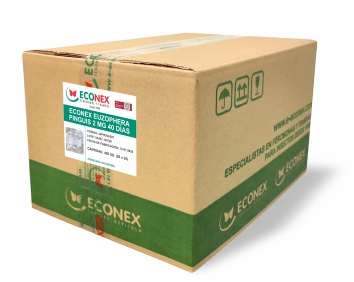
ECONEX EUWALLACEA SPP 60 DAYS 1 UNIT is an attractant consisting of 4 blister-shaped diffusers to attract females of Euwallacea fornicatus sensu lato, with a 60-day duration in the field.

ECONEX EUWALLACEA SPP 60 DAYS 1 UNIT
Attractant consisting of 4 blister-shaped diffusers for the biocontrol of Euwallacea fornicatus sensu lato, with a 60-day duration in the field.

Code: UIPHOVA463

For proper operation, the use of CROSSTRAP® MINI, trap is recommended, a modern trap for capturing coleoptera insects in flight. This trap was developed in a R&D project (University of Murcia - ECONEX) aiming at developing traps and attractants for forest insects.

The sheets, funnel and collector are treated with a slippery product that significantly increases catches and prevents escape. The trap can be operational for up to 7 years due to its nature and high-resistance components.

The trap can be used with two types of collectors: CROSSTRAP® MINI WITH WET COLLECTION CUP (with slider) for wet catches, and CROSSTRAP® MINI WITH DRY COLLECTION CUP (with slider) for dry or live catches.

CROSSTRAP® MINI WITH DRY COLLECTION CUP (with slider)
Trap for interception of coleopteran insects during flight.

Code: UIPFETA204
OMDF registration number (Spanish ministry of agriculture): 153/2013

CROSSTRAP® MINI WITH WET COLLECTION CUP (with slider)
Trap for interception of coleopteran insects during flight.

Code: UIPFETA226
OMDF registration number (Spanish ministry of agriculture): 153/2013

Composition

These traps consist of a polypropylene lid with a central carabiner attached to a stainless-steel spring and two reinforced PVC sheets anchored at the top to the lid by four stainless steel springs that act as shock absorbers against strong winds, helping to prevent damage to the trap. At the bottom, the reinforced PVC sheets are attached by steel springs to a 30 cm diameter polypropylene funnel. At the end of the funnel is the container for retaining the captured insects.

The PVC sheets, funnel and collection cup are treated with a sliding film.

New funnel:

For the environmental impact to be reduced, a removable funnel has been launched in 2024, following several years of research, which optimises trap transport and reduces carbon emissions.

embudo-de-crosstrap nuevas-caracteristicas

Types of collectors:

Depending on the purpose of the trap, choose between the CROSSTRAP® DRY COLLECTION CUP (with slider) or CROSSTRAP® WET COLLECTION CUP (with slider) 1 L.

CROSSTRAP® DRY COLLECTION CUP (with slider) container has a stainless-steel mesh at the bottom that allows rainwater to be evacuated. It has an approximate capacity of 1 litre (11 cm diameter x 13.5 cm high) and is used for dry or live captures.

CROSSTRAP® WET COLLECTION CUP (with slider) 1 L container has an approximate capacity of 1 litre (11 cm diameter x 13.5 cm).

Wet catches allow for accurate identification of the catch. To do this, filling the collector with 10 ml of propylene glycol diluted to 10 or 20% is recommended, or, if necessary, car antifreeze can be used. This liquid serves both to kill the catch and as a preservative, as long as rain does not excessively dilute it, in which case it should be replaced.

COLECTOR HUMEDO CROSSTRAP

CROSSTRAP® WET COLLECTION CUP (with slider) 1 L
Collection cup for wet catches, located at the bottom of CROSSTRAP® traps.

Code: UIPFETA311

boton comprar

COLECTOR HUMEDO CROSSTRAP

CROSSTRAP® DRY COLLECTION CUP (with slider)
Collection cup for dry use, or live catches, located at the bottom of CROSSTRAP® traps.

Code: UIPFETA157

boton comprar

COLECTOR SECO CROSSTRAP

CROSSTRAP® DRY COLLECTION

View from below


Storage of diffusers

The product should be stored in its original packaging in a refrigerator at 4ºC or in a freezer at -18ºC, in which case it will remain effective for 90 and 150 days respectively. Keep away from food and drink.


Trap packaging


CROSSTRAP® MINI WITH WET COLLECTION CUP (with slider)

Corrugated cardboard box containing 16 units.
Box dimensions: 0.60 x 0.80 x 0.48 m (width x length x height).
Box weight: 19 kg.
Number of boxes per pallet: 16
Pallet dimensions: 0.80 x 1.20 x 2.05 m (width x length x height).
Pallet weight: 162 kg.

Caja con 8 unidades

Box containing 16 units.


CROSSTRAP® MINI WITH DRY COLLECTION CUP (with slider)

Corrugated cardboard box containing 16 units.
Box dimensions: 0.60 x 0.80 x 0.48 m (width x length x height).
Box weight: 19 kg.
Number of boxes per pallet: 16
Pallet dimensions: 0.80 x 1.20 x 2.05 m (width x length x height).
Pallet weight: 162 kg.

Caja con 8 unidades

Box containing 16 units.


Recommended information:


ECONEX EUWALLACEA SPP 60 DAYS LEAFLET

Leaflet in PDF format that can be downloaded by clicking on the image.

TRÍPTICO DACUSNEX© COMBI


www.crosstrap.es

Specific website for ECONEX solutions for green areas, which you can access by clicking on the image.

ESQUEMA DE MONTAJE EMBUDO CROSSTRAP


www.greenareas.e-econex.eu

ECONEX solutions specific website for green areas, which you can access by clicking on the image.

ESQUEMA DE MONTAJE EMBUDO CROSSTRAP


ECONEX LEARNING CENTER

ECONEX puts at your disposal the first open knowledge center that brings together everything necessary to implement pest biocontrol in your crops. We have developed different types of resources to share with you the knowledge we have acquired during our more than 40 years of experience. Each of them is designed to respond, in the best possible way, to different questions related to pheromones, attractants, repellents and insect traps.

To access ECONEX LEARNING CENTER click on the image.

Web resources

This website uses first-party and third-party cookies to collect statistical information about your web browsing habits, in order to improve and personalise your experience on our website by offering content that interests you.

If you continue browsing this website, we consider that you accept the installation and use of cookies. You can change the configuration or obtain more information in Cookies policy.